← All projects

06 / Business strategy

Design & Entrepreneurship

How design methods can help young businesses understand their markets, organise for growth and build partnerships.

Context
Entrepreneurial electives · Delft Centre for Entrepreneurship · TU Delft
Cases
Kitepower · Vattenfall’s Cake spin-off · Stadsgrond
01 / Design beyond the product

Designing for a business to last

During my master’s, I took courses at the Delft Centre for Entrepreneurship to extend my design skills with a stronger market perspective. A product, service or system can improve through many design iterations, but it also needs a business that can maintain and develop it over time.

By analysing several startups, I explored the pressures faced by innovative but vulnerable companies. Their development stages reminded me of the iterative design process: teams need to recognise what the business needs next and organise the right people and resources around that priority. This made me interested in how design can inform market strategy and help a business grow.
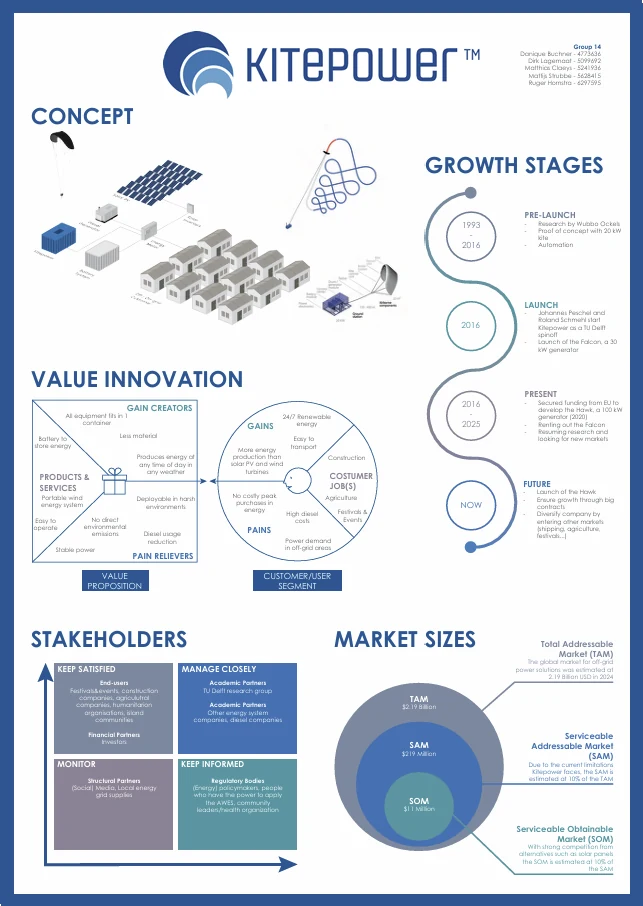
Kitepower concept, growth stages, value innovation, stakeholders and market-size overview.
Kitepower: an overview of the concept, value innovation, stakeholders, growth stages and potential markets.
02 / Startup and corporate innovation

Making collaboration work

For a study of Vattenfall’s startup spin-off Cake, I looked at how a large company can work with a young venture through intellectual property. The case showed how startups can bring new ideas into an established industry, while larger organisations contribute experience, reach and resources.

My research led to recommendations for Vattenfall’s startup programme, including changes to parts of two incubation models. The comparison below summarises how low-selective, supportive and incubator models differ across financial, organisational, human, technological, network and infrastructure resources. A separate course on patents also taught me why intellectual property matters when designing products that use new technology.
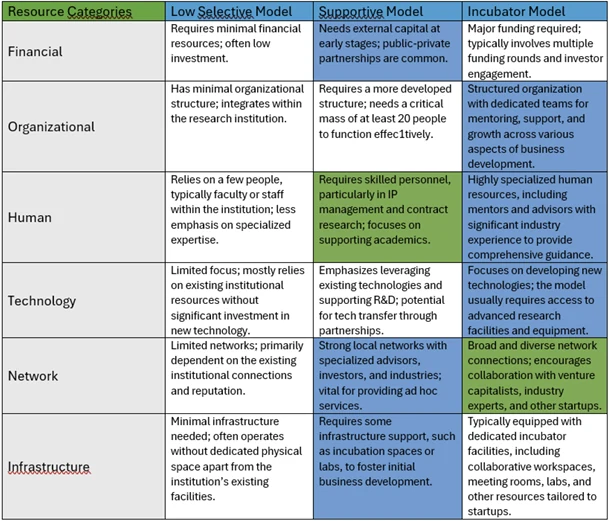
Comparison table of low-selective, supportive and incubator models across financial, organisational, human, technology, network and infrastructure resources.
Resource needs across three startup incubation models informed the recommendations for Vattenfall’s programme.
03 / Stadsgrond

A business model for circular bricks

Stadsgrond is a Rotterdam startup making circular, fully sustainable bricks from locally sourced clay. Our team used market research and strategy tools to understand where the company could create value, who it should serve and what could help it grow. We combined these methods to develop a business-model direction, prioritise tasks and identify practical next steps, including how Stadsgrond might eventually partner with larger firms.
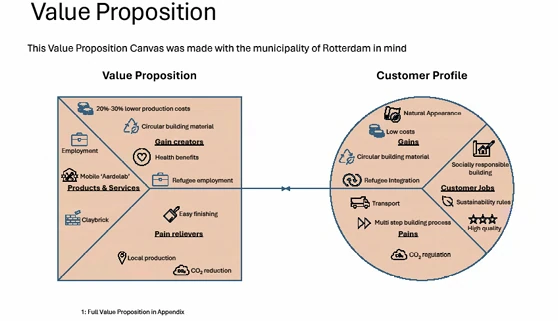
Value proposition canvas for Stadsgrond connecting circular brick benefits with customer jobs, gains and pains.
The value proposition canvas maps customer needs against the benefits of locally made circular bricks.
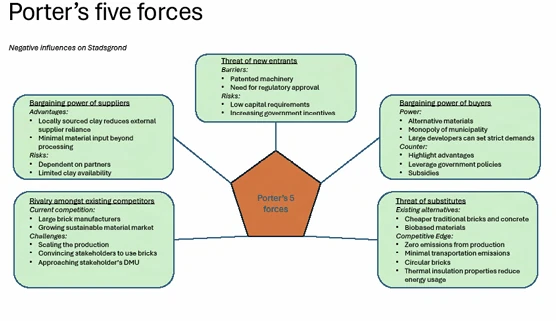
Porter’s five forces analysis of competition, suppliers, buyers, new entrants and substitutes for Stadsgrond.
Porter’s five forces helped assess the competitive pressures around the venture.
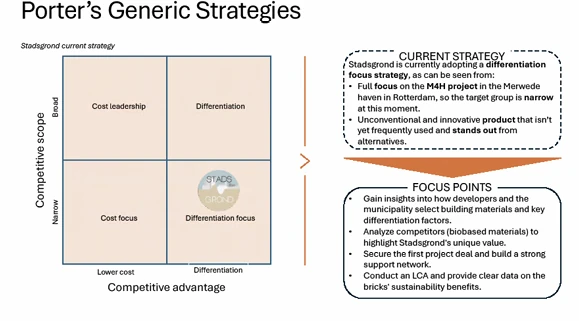
Porter’s generic strategies matrix and strategic focus points for Stadsgrond.
Porter’s generic strategies were used to clarify Stadsgrond’s competitive position and focus.
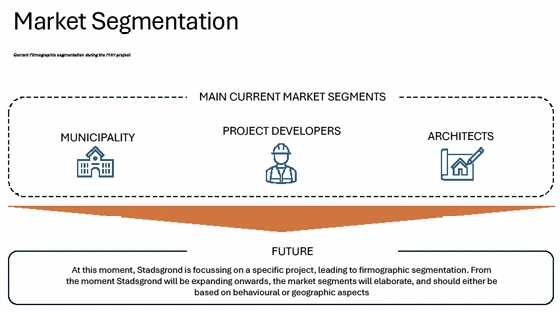
Stadsgrond market segmentation diagram identifying municipalities, project developers and architects as current customer groups.
Market segmentation identified municipalities, project developers and architects as relevant customer groups.
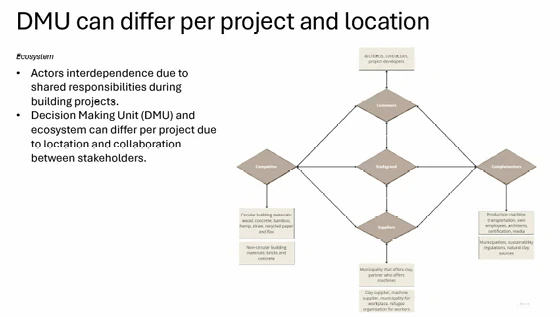
Decision-making unit diagram showing how project stakeholders and responsibilities can vary by location and collaboration.
The decision-making unit can change between projects as stakeholders and responsibilities shift.
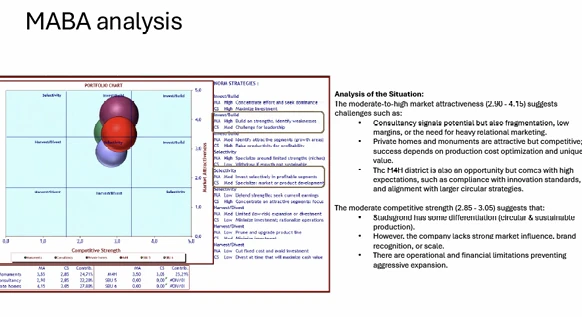
MABA portfolio analysis comparing market attractiveness with Stadsgrond’s competitive strength.
MABA analysis compared market attractiveness with the venture’s competitive strength.
04 / Growth and business-model options

Prove value, then choose how to scale

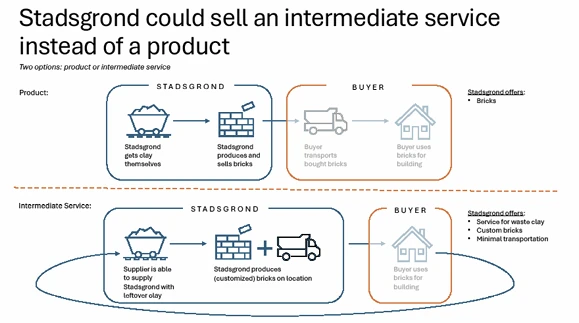
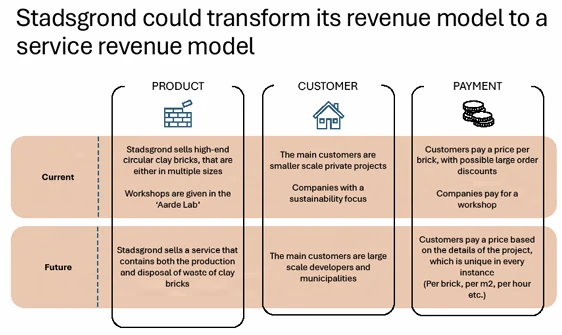
The analysis suggested that Stadsgrond should first prove its bricks with smaller projects, build credibility through certification and then approach larger contractors and project developers. We also explored different ways to earn revenue: continue selling bricks, offer brick production as a service, or provide an intermediate service that takes in local clay and delivers customised bricks at the project location.

These options connect the company’s growth stage to its customers, operations and partners. They offer different routes to scale and provide a basis for testing which model best fits the market.
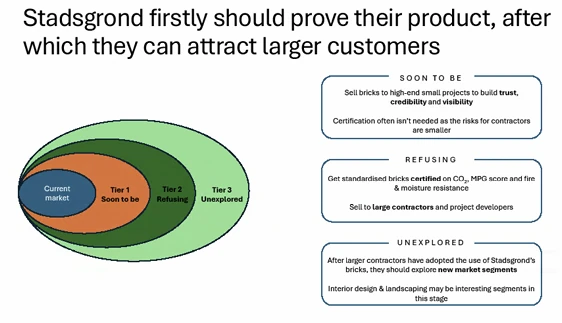
Stadsgrond growth stages from proving the product with current customers to larger customer tiers, with suggested actions for each stage.
A staged growth path starts by proving the product and builds towards larger customers.
Current and future Stadsgrond revenue models comparing brick sales with a service for producing and disposing of bricks.
A service model could combine brick production with the collection and processing of waste bricks.
Comparison of selling bricks directly with offering an intermediate service that makes and transports customised bricks from local clay.
An intermediate service could process local clay and deliver customised bricks at the building location.
Project descriptions and visuals adapted from my portfolio. Read the full portfolio ↗
Next projectRedesigning Innovation